 Sorrento City Guidebook
Is Sorrento worth visiting? The honest verdict
Is Sorrento worth visiting? The honest answer is that it depends on what the town is for in your trip, and this page settles that question with evidence instead of adjectives. Sorrento is two things at once: a compact cliff-top town of squares, cloisters and lemon groves that fills about one day of sightseeing, and the working base for Capri, Pompeii and the Amalfi Coast, where the ferries dock, the trains terminate and the day-trip arithmetic actually adds up. Ask whether the town alone justifies the flight and the answer is shaky; ask whether the base earns its premium and the answer, computed below from official fares, is yes for most first-time visitors and no for a few honest cases we name.
Quick answer The verdict in two sentences, who it fits, who it does not, and where the arithmetic sits
Yes, Sorrento is worth visiting if you treat it as a base: the town itself is one good day, and the value sits in the ferries to Capri, the train to Pompeii and the buses to the coast that start here. Skip it or shorten it if you want a sand beach, a quiet village or the coast road as the destination itself.
Key takeaways
- The day-trip arithmetic, computed from official 2026 fares, is in the base arithmetic table below
- The Sorrento versus the coast question is argued properly on the Sorrento or Amalfi Coast page; the short version is base in Sorrento, visit the coast
- A guided walk of the centre at $57 listed is the cheapest way to test the town on day one, and a coast cruise at $23 listed is the cheapest way to test the water
The short verdict
Sorrento is worth visiting for the trip it makes possible, not for the checklist it contains. The town's own inventory is small and honest: two squares, a cathedral, a cloister, a museum, a belvedere terrace, a gorge you photograph from a bridge and two marinas. A brisk visitor covers it in a morning; a comfortable one spreads it over a day with a long lunch at the harbour. Beyond that first day, Sorrento's job changes: it becomes the place where you sleep, eat, and walk home from the station, and the days are spent on the water and in the ruins. Judged as a single-destination holiday town, it is a thin programme for the money. Judged as the base, it is the most practical address on the peninsula, and the official transport geography explains why: the Circumvesuviana rail line terminates here, the hydrofoils to Capri and Naples dock at Marina Piccola, and the coast buses start from the centre.
That division is also why the question "is it worth it?" splits so cleanly by traveller. The people who rate Sorrento highly in reviews almost always stayed several nights and used it as a hub; the people who call it overrated usually day-tripped in, saw the compact centre in two hours, and paid for the privilege. Both are correct, because they priced two different products. The sections below name who each product fits, print the cons that the postcard pages leave out, and then compute what the base actually costs per day out.
Who Sorrento is right for
The town fits a specific traveller well, and it is worth naming that traveller precisely before booking anything.
The first-timer who wants Capri, Pompeii and the coast in one trip. Sorrento is the only town that reaches all three without a car and without changing addresses. The ferry to Capri takes about 25 minutes from Marina Piccola, the Circumvesuviana to Pompeii about 35 minutes from the station in the east of the centre, and the SITA coast bus departs from the same block. A holiday here is not one holiday but several, stitched together by short transport legs.
The traveller who does not want to drive. The coast road is beautiful and exhausting, the Amalfi side is worse, and summer parking is the worst of all. Sorrento lets a visitor park the car once for the whole stay, or skip the car entirely, and the parking page explains what that costs if you did drive down.
The evening person. Unlike the coast villages, which empty after the day boats leave, Sorrento keeps its streets busy at night: restaurants, passeggiata, bars on the square. A coast village is a daytime beauty; Sorrento is a place that is still awake when you want dinner at nine.
Families and mixed-ability groups. The flat main street, the lift down to the ferry pier and the wide choice of hotels make logistics survivable; the family page carries the stroller-and-steps detail and the accessibility page carries the wheels-and-ramps detail.
The traveller watching the budget. Not because Sorrento is cheap, it is not, but because the alternatives are dearer for the same access: sleeping on Capri or in Positano costs more for fewer transport options. The honest costs page itemises what the town actually charges.
The fit table below compresses the verdicts; the last column routes to the page that argues each case in full.
| If your trip is mostly... | Verdict | Why | Read this |
|---|---|---|---|
| Capri, Pompeii and a coast day, no car | Sorrento fits | All three start here by train, ferry or bus | Day trips |
| A beach holiday | Sorrento disappoints | The shore is rock platforms and lidos, not sand | Beaches |
| Slow village evenings on the Amalfi side | Base on the coast instead | Sorrento is livelier, busier and bigger than a village | Sorrento or Amalfi Coast |
| One night between Naples and the coast | Works, barely | The centre is one day, so one evening is enough | One day itinerary |
| A week without changing hotels | Sorrento fits | Enough restaurants and three day-trip directions | Two days and three days |
Who should base elsewhere
Three travellers should not base in Sorrento, and saying so is more useful than defending the town.
The sand-seeker. Sorrento's shore is a tuff cliff meeting the sea, and swimming happens off lido platforms and concrete terraces, not beaches. Marina Grande's pebble crescent is charming at lunch and modest for a swim day. If the mental image of the holiday is toes in sand and a long shallow entry into water, the beaches page makes the honest comparison and the coast or Ischia wins it.
The coast-wanderer. If the dream is stepping out of a Positano hotel into the village's stair lanes at eight in the morning, before the boats arrive, then Sorrento as a base adds a commute to the exact thing you came for. The ferry schedule makes day-hopping possible but the early-morning and after-five hours, the best ones, belong to whoever sleeps there. That trade is argued in detail on the Sorrento or Amalfi Coast page, and it is a real trade, not a wrong answer.
The repeat visitor. Travellers who have already done Capri, Pompeii and the coast loop often find their second Sorrento holiday has less to stand on, because the town's own sights fit one day. Ischia, Vesuvius and the smaller peninsula towns refresh the programme, but if none of those appeal, a coast village or Naples gives the same sea with new streets.
One more honest case: the traveller arriving by car who plans to explore the peninsula by road every day. Sorrento works as a base for a car, the garages are professional, but the peninsula's roads reward a smaller home address in the middle of the map. The car question page is the decision point for that trip.
The honest cons
Every town has a gap between the postcards and the pavement. Sorrento's gap has four parts, and each one is fixable with knowledge rather than money.
The crowds concentrate on one square. Piazza Tasso and the few streets around it absorb every tour group in the town between about ten and five. The town is small enough that two lanes of walking put you in quiet residential streets, but the first impression, the one you get off the train or the bus, is the most crowded spot in town. Walk ten minutes in any direction and the pressure drops; the old town lanes and the Villa Comunale terrace recover the town's dignity fast.
The town is touristy in its shop front. Via San Cesareo and the streets feeding it sell lemons, ceramics and magnets at tourist prices. This is a shop-front problem, not a town problem: one street back, the ironmonger, the tailor and the neighbourhood bars are doing Sorrento's actual business. Shop with your eyes open and treat the main drag as a museum of itself.
There is no beach. Covered above and worth repeating here because it is the number one disappointed-expectation generator: the town's relationship with the sea is vertical, not horizontal. Lidos price by the season and the beaches page explains the platforms.
The edges are cliffs and the centre sits on a plateau above two ports. Every descent costs stairs, a ramp or a switchback road, and the return climb is real. The accessibility page and the getting around page carry the details, including the public lift that takes the sting out of the ferry-pier descent.
None of these cons argue against the town; they argue against arriving uninformed. The verdict that survives them is the base verdict, and the section below this one prices it.
What Sorrento is special at
Worth naming too, because the cons list runs long and the town earns its reputation on specific strengths.
The cliff-edge views. The tuff coast drops to the bay, and the town's gardens and terraces sit on the edge: the Villa Comunale belvedere, the hotel terraces, the restaurant balconies. This is the view people mean when they say Sorrento, Vesuvius across the water, the whole gulf in one frame, and it is public property at the Villa Comunale for the price of a walk.
The citrus economy. The lemons here are a protected variety, the limoncello industry surrounds them, and the town's shops, groves and tastings all trade on it. A limoncello tasting or the lemon groves behind the centre are the town's most local experience.
The quiet monuments. The Chiostro di San Francesco, a medieval cloister of crossed volcanic-stone arches, is the town's best room and costs nothing to enter; the cathedral and the Basilica di Sant'Antonino are working churches with real art. The Correale museum, when it is open, is the town's one paid sight.
The evenings. The passeggiata on Corso Italia, the harbour restaurants at Marina Grande, the bars around Piazza Tasso at eleven at night. The coast villages go dark early; Sorrento does not.
The transport. Trains, ferries, buses and boats all start here. The section below this one turns that strength into numbers.
The base arithmetic
This is the calculation that should decide the question for most visitors. The value proposition of Sorrento is access, and access has official prices. Below, each classic day out from Sorrento is priced from the operator's own 2026 fare, then the days are added up against a stay. The fares are per person; the tourist tax is the room's add-on at checkout, banded by hotel category and capped at seven nights. Nothing here is an estimate: every transport and entry figure is printed by its operator, and the dollar glosses are computed at the ECB rate of 11 September 2026.
The shape of the table is the argument. Three world-class day trips, each reachable for less than the price of a museum-and-lunch afternoon in most capitals, with no car, no parking and no driving. That is the product the town sells, and it is a good product. The room is where the premium sits, and the tax band's top line of $5.80 (€5) a night tells you the hotel stock knows it.
Official fares and entry prices, per person, read on 12 September 2026 from NLG, EAV fare guides and the operators' pages; dollar glosses at the ECB rate of 11 September 2026.
| Day out from Sorrento | Official cost per person | In dollars | Time from the centre |
|---|---|---|---|
| Pompeii by Circumvesuviana, return train plus Express entry | €10.80 train return plus €20 entry | $12.52 plus $23.20 | About 35 minutes each way by train |
| Capri by ferry, return plus the island landing fee | €44 return plus €5 landing fee April to October | $51.00 plus $5.80 | About 25 minutes each way from Marina Piccola |
| Positano by ferry, one way out, ferry back | €21.50 each way on the NLG line | $24.90 each way | About 35 minutes each way, April to early November |
| Naples by Circumvesuviana, return | €10.80 return | $12.52 | About 70 to 75 minutes each way |
| Vesuvius Gran Cono trail, entry only | €11.68 online only | $13.54 | By bus or tour for the road legs |
| The town itself: cloister, churches, belvedere | €0, the free loop | $0 | On foot all day |
Three worked days, no car, per person, using only the fares above: the Pompeii day costs about $35.70 (€30.80) with a modest counter lunch; the Capri day about $56.80 (€49) in transport and landing fee before any food on the island; the beach-and-town day about $8.69 (€7.50) if the lido is skipped. A five-night stay in a 4-star hotel adds $23.20 (€20) per person in tourist tax at the 2026 band. Set against coast-village room rates for the same access, that arithmetic is the honest reason Sorrento is worth visiting for the first-time peninsula trip.
What the stay costs, briefly
The verdict has a price tag, and it is worth glancing at it here before the arithmetic section, because worth is a ratio. The room is the big variable and the town's premium lives there; the town's own published tax band, topped at $5.80 (€5) per person per night in 5-star hotels, tells you the hotel stock skews to the top categories. Meals run from counter lunches to harbour dinners, the sightseeing is either free or the one museum at $17.39 (€15), and the day trips, priced in the table below, are the cheap half of the trip. A visitor can spend heavily here, usually on the room and the terrace drinks, or spend moderately and lose almost nothing of the experience, which is a claim most resort towns cannot make.
The full itemisation, every named price with its source and date, is the costs page's job, and the honest summary is its conclusion: Sorrento is expensive to sleep in, moderate to eat in and cheap to walk around. For the worth-it question, that shape matters, because the thing the premium buys, the base position, is exactly the thing this page's arithmetic values. The traveller who pays Sorrento room rates and never leaves town has bought the wrong product; the traveller who pays them and day-trips on the fares below has bought the right one.
How many days the verdict needs
The town itself is one good day, and the itineraries on this site prove the point by construction: the one-day plan covers the whole centre at walking pace, the two-day plan adds the first day trip, and the three-day plan is the full base experience with Capri, Pompeii or the coast slotted in. A visitor with a single day in Sorrento should spend it in the town and not on a boat, because the centre repays exactly one day and the boats need the morning; a visitor with three or more nights gets the full product the town exists to sell.
The shortest honest answer to the worth-it question is therefore a length: one day is enough for the town, three to five nights is the length that makes the base worth it, and between those two poles sits the awkward two-night trip that pays the base premium for one full day trip. If the calendar only allows two nights, either add the third or move the base closer to the coast and accept the trade.
The final call, in one sentence
Book Sorrento if your peninsula trip is built on day trips and evenings, judge the town by its harbour dinners and cloister rather than its beachless shore, and skip it for a sand-and-village holiday; and if the question is really Sorrento versus the coast, the Sorrento or Amalfi Coast page makes that call in detail, with the same rule underneath: base where the transport is, sleep where the evenings are. When the town part of the plan is settled, the Sorrento city guide front page keeps the rest of the site one click away.
Tours that test the verdict cheaply
The cheapest ways to buy the two halves of the verdict, the town and the water, plus the day trips the base exists for; listed prices read on 12 September 2026. Every card links to the operator's own page, where the date calendar shows live availability.
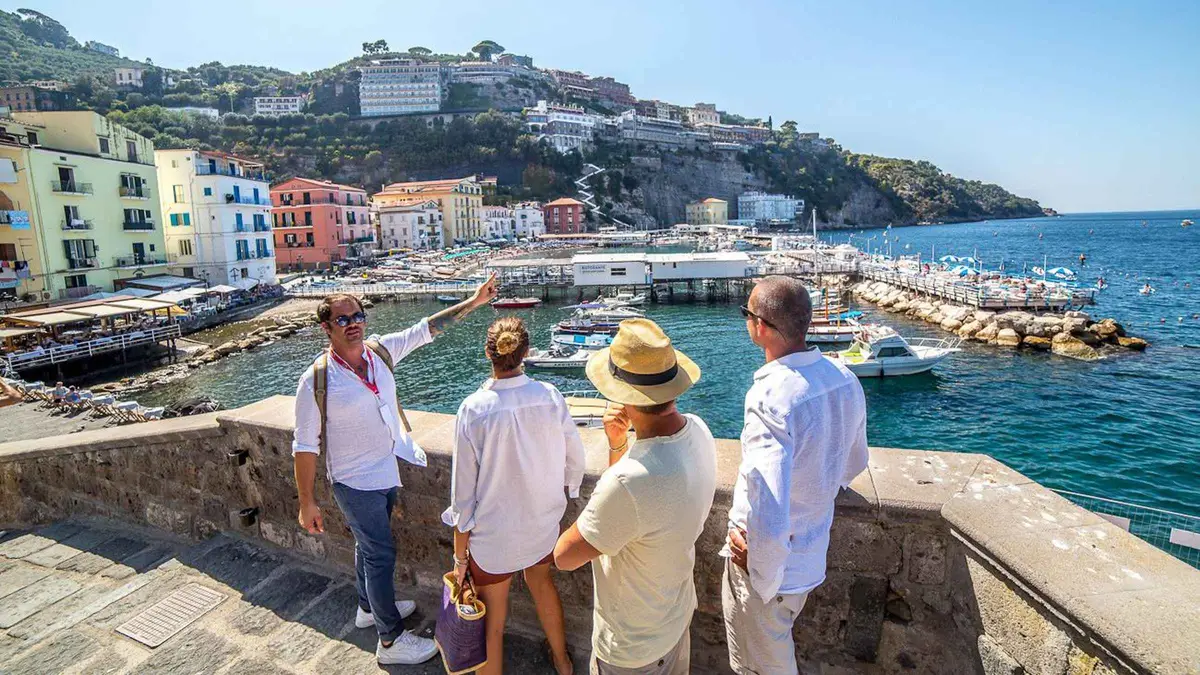 from $57
Sorrento: Walking Tour with Local Guide
A 2.5-hour private orientation walk with a local guide — the first-morning option.
Check Availability from $23
Sorrento Coast Cruise with Limoncello Tasting
A one-hour daytime coast cruise with a swim stop and limoncello on board. The taster option for tight schedules.
Check Availability from $75
From Sorrento: Capri Boat Tour with Free Time on the Island
The budget-shaped option: crossing and circuit of the island with free time ashore in Capri town. Larger boat, fewer frills.
Check Availability from $142
Sorrento: Pompeii and Mount Vesuvius Day Trip with Guide
A guided Pompeii + Vesuvius day by coach with a licensed guide at both stops. The classic pairing in one day.
Check Availability from $110
Sorrento: Pasta and Tiramisu Cooking Class with Wine
A three-hour pasta and tiramisu class with wine, in central Sorrento. The default first cooking class.
Check Availability from $46
Sorrento: Shared Transfer to Naples Airport or Train Station
A shared shuttle between Sorrento and Naples airport or train station, about two hours door to door.
Check AvailabilityPrices, ratings and details are the platform's own, checked in Q3 2026; dollar figures are the listed prices — the platform bills in your account's currency.
Where the verdict continues
Four pages carry the next decision: the head-to-head with the coast, the money, the season and the shape of the days.
Sorrento or Amalfi Coast
The same verdict question aimed at the base-versus-village trade, with the ferry and bus timetables that decide it.
The head-to-headWhat Sorrento costs
Every named price on the site, itemised with its source, from the tourist tax bands to the ferry fares.
The money behind the verdictBest time to visit
The crowds that fill Piazza Tasso in July empty it in November, and the verdict moves with them.
The season changes the answerSorrento in 2 days
The two-night trip that pays the base premium properly: one town day, one day trip, no waste.
The verdict at minimum lengthIs Sorrento worth visiting: questions
Is Sorrento worth visiting?
Yes, as a base; that is the verdict this page argues with fares rather than adjectives. The town itself is one good day of squares, cloister and harbour, and the value sits in what starts here: the ferry to Capri at $25.50 (€22) one way, the train to Pompeii at $6.26 (€5.40) each way, the coast buses. If your trip is the town alone, one day is enough; if your trip is the peninsula, the base earns its premium. The day trips hub lists what starts here.
Is Sorrento worth visiting for a day?
It is worth a day, with the caveat that a day buys the town, not the base. Walk the centre in the morning, the cloister and the cathedral, lunch at Marina Grande, the belvedere at the Villa Comunale in the afternoon, and leave the boats for a trip with an overnight in town. The one-day itinerary routes it stop by stop.
What is so special about Sorrento?
Three things the neighbours cannot copy: the cliff-edge view across the whole gulf from public gardens, the transport position where the Capri ferries, the Pompeii train and the coast buses all start, and the evenings, because the town stays awake after the day boats leave. The lemons and the limoncello trade built on them are the local flavour; the limoncello tasting page covers the producers.
Is Sorrento nicer than Amalfi?
They are different tools, and nicer is the wrong axis: Amalfi is a destination village you visit, Sorrento is a base you live in, and Sorrento wins on transport, evenings and room rates while Amalfi wins on the one-village postcard. The full comparison, with the timetables that decide it, is on the Sorrento or Amalfi Coast page.
Who should skip Sorrento and stay somewhere else?
Sand-seekers, because the shore here is lido platforms rather than beaches; coast-wanderers who want to wake up inside a Positano or Amalfi lane; and repeat peninsula visitors who have already done the three classic day trips. Everyone else gets more access per night here than anywhere else on the peninsula.
How many days in Sorrento is enough?
One for the town, three to five for the base. The centre fits a single comfortable day, and each additional night converts cleanly into a day trip: Capri, Pompeii, the coast, Vesuvius or Ischia. Two nights is the awkward middle that pays the base premium for one full excursion day, so either add the third or shorten the stay.
Is Sorrento worth the premium over staying in Naples?
For a peninsula holiday, yes: Naples is cheaper and grander but adds 70 to 75 minutes of train to every Pompeii and coast morning and puts Capri's ferries further away. For a city trip with one coastal day, Naples wins. The arrival arithmetic, every route priced, is on the Naples to Sorrento page.
Is Sorrento Worth Visiting on film
Three walk-throughs verified on YouTube: what the place actually looks like before you book anything.
THIS Is WHY You Should Visit SORRENTO | 6 Reasons Sorrento Should Be Your Next Destination In Italy
Verified via oEmbed (NALBA TRAVELS); matched query 'is sorrento worth visiting'.
Video: NALBA TRAVELSTop 10 Things to do in Sorrento, Italy - Travel Guide [4K]
Verified via oEmbed (ViaTravelers); matched query 'is sorrento worth visiting'.
Video: ViaTravelersIs Sorrento, Italy Worth Visiting?
Verified via oEmbed (Big & Small Travel); matched query 'is sorrento worth visiting'.
Video: Big & Small TravelVideos load from YouTube only when you press play.
Reviewed Q3 2026 (July–September 2026); next review Q4 2026. Prices, hours and terms are set by the venue or operator and confirmed at checkout.
We may earn a commission if you book through one of our links, at no extra cost to you. Full affiliate disclosure