 Sorrento City Guidebook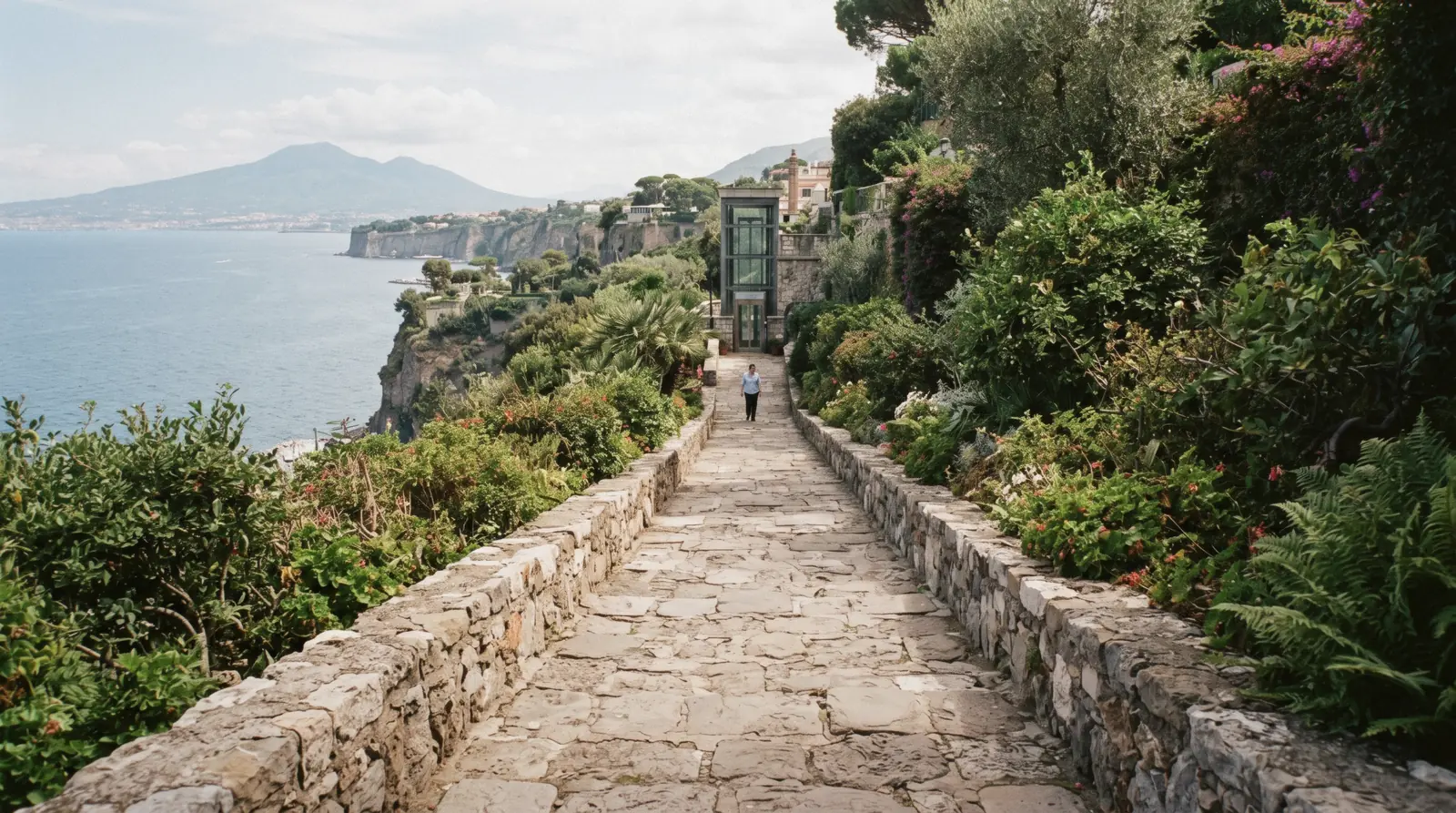
Sorrento accessibility: the wheelchair and mobility reality
Sorrento accessibility is decided by one piece of geography, and this page states it plainly before anything else: the town is a flat plateau on top of a cliff, so almost everything a visitor wants on wheels is up top, and almost everything below the plateau, both ports and every bathing platform, is reached by lift, ramp, stairs or a switchback road. Sorrento accessibility for wheelchair users and anyone with limited mobility is therefore workable in the centre and demanding at the edges, and the honest gaps are printed here rather than papered over. We read the venues' own pages for their accessibility claims, quote exactly what each one states, mark everything else not stated, and end with a one-day plan that keeps the whole visit on the flat.
Quick answer The plateau answer, the lift question, and what the venues' own pages actually claim
Sorrento is partially wheelchair accessible: the plateau, the main street, the squares and the Villa Comunale gardens are step-free and workable, while the old-town lanes are cobbled and both marinas sit below the cliff with lift, ramp or road as the only routes. The public lift from the gardens down to Marina Piccola exists, but its fare and hours are not published, and no official city accessibility inventory exists to check either claim against.
Key takeaways
- The street-by-street wheels table is in the what works on wheels section below
- The venue claims, quoted from their own pages, from the Correale's one-line statement to the ferry operator's assistance policy, are compared in the venues table
- The accessible day plan keeps the whole visit on the flat, ending at the belvedere
The cliff-town problem, stated plainly
Every accessibility question in Sorrento resolves to the same cliff. The town's centre is a plateau roughly level from the train station in the east to the gardens at the western edge, and on that plateau the town is one of the easier small Italian centres on wheels: wide streets, level paving, dropped kerbs on the main drag, and a compact grid where nothing is more than fifteen minutes' push. Below the plateau, the town meets the sea down a tuff cliff of several storeys, and the two marinas, the bathing lidos and the ferry pier all sit at the bottom of it.
The honest state of the paperwork is the next fact a wheelchair traveller needs, and it is a negative finding worth having before booking: no official city accessibility inventory exists for Sorrento. The municipality publishes tourist maps and fountain maps, but there is no audited step-free route map of the town, no published list of accessible kerbs, lifts and public toilets, and no official statement of the lift's fare and hours that we could find. What exists instead is the venue-by-venue picture, each venue's own page saying what it says, and this page's street-level routing, which is ours and marked as such. Anyone planning around a hard requirement should treat that routing as a plan to verify on arrival rather than an audited guarantee.
What the cliff problem does not mean is that the trip fails. It means the trip is designed from the plateau outward: the day lives on the flat, the ports are reached by lift or car or taxi where the wheels allow, and the stairs, the hundreds of them in the old-town shortcuts and the marina paths, are routed around rather than suffered. The sections below do exactly that, street by street, venue by venue.
What works on wheels
The plateau's step-free core is real and worth mapping precisely, because it covers the town's main sights. The main street, Corso Italia, runs flat and smooth from the station quarter through the shopping blocks to Piazza Tasso, with signalised crossings and kerbs dropped at most corners. Piazza Tasso itself and the square of Sant'Antonino beside it are level stone, and the streets between them carry the town's cafes at their most seated-and-served. The Villa Comunale gardens at the cliff edge are the plateau's best room: level paths, railed belvedere, benches with the view, and the public lift down to the ferry pier on their western side. The cathedral sits a level block off the main street, though its approach lane is narrower paving and the portal has steps at the door.
The old town is the plateau's rough half. The lanes south of the main street, Via San Cesareo and the weave around it, are cobbled, cambered and occasionally stepped where they run down toward the cliff, and they are the part of Sorrento that photographs best and rolls worst. A robust chair with a pusher manages short stretches; a power chair or a solo manual push should plan the old town as a there-and-back on the smooth cross streets rather than a lane-crawl. The cloister at the old town's western end is reached over level ground from the main street side, but its own thresholds and the chapel step are exactly the kind of detail no official page documents, hence the verify-on-arrival rule.
The table below compresses the routing. It is our assessment from the town's surface geography, not an audited municipal statement, and the getting around page carries the same streets with their walk times.
The town's surfaces and spaces, rated for wheels from the street geography; this is our routing, marked as ours, because no official inventory exists to quote.
| Space | Surface and slope | Wheels verdict |
|---|---|---|
| Corso Italia, station to Piazza Tasso | Smooth, level, dropped kerbs | Step-free, the daily spine |
| Piazza Tasso and Piazza Sant'Antonino | Level stone paving | Step-free, cafes seated around the edges |
| Villa Comunale gardens and belvedere | Level paths, railed edge | Step-free, plus the lift to the pier |
| Old-town lanes, Via San Cesareo and around | Cobbles, camber, occasional steps | Rough; short stretches or a pusher |
| Cathedral approach and portal | Narrow lane, step at the door | Partial; verify assistance on arrival |
| Marina Grande road | Steep switchback road, narrow pavements | By car, taxi or bus rather than wheels |
The ports and the lift question
The lift is the single most consequential piece of accessibility infrastructure in Sorrento, because it is the difference between a step-free ferry morning and a cliff descent. The public lift stands at the western edge of the Villa Comunale gardens and drops to the Marina Piccola ferry pier area, where the Capri and Naples hydrofoils dock. It exists, it is public, and it is the routing every wheels traveller should plan around. Beyond that, the published record goes quiet: the lift's fare is not stated anywhere we could verify, its operating hours are not stated, and the operator's own site was not reachable when we checked, so this page prints the honest version, carry coins for a small fare and hold the pedestrian ramp through the gardens as plan B, and re-check the Marina Piccola page before the ferry day.
Marina Piccola's pier itself is a working port, not a terminal: the gangways to the fast boats are ramps by sea standards and stairs by street standards, and the ferry operator's own assistance policy, quoted properly in the table below, is the document that governs boarding. The short version: assistance is offered for the whole journey by crew, but passengers travelling in wheelchairs must be able to transfer to a seat, because sailing while remaining in the chair is not permitted for regulatory reasons, and an accessible bathroom aboard is not guaranteed on any given departure. Ask at the ticket office when buying, which is exactly where the operator says the wheelchair-bathroom answer is available.
Marina Grande, the fishing harbour, has no lift: it is reached by the switchback road, by the local bus, by taxi or by the long stairways, and on wheels the honest routing is a car or taxi down and back. The harbour's restaurants sit level on the quay, so the arrival is the only hard part. The Marina Grande page carries the harbour in detail.
Venues that state it and venues that do not
Because no city inventory exists, the venue's own page is the only document with any authority on its accessibility, so we read them and quote them rather than paraphrasing hospitality into something firmer. The result splits cleanly into three groups: venues whose own pages make a claim, venues whose pages are silent, and one operator whose policy exists but carries conditions. The museum's statement is the town's most quoted and least informative, a single line with no detail behind it, and that one line is exactly what this page prints, no more, no less.
What each venue's own web page states about access, read on 12 September 2026, with the page's exact claim or the honest negative; where a claim has no detail behind it, the table says so.
| Venue | What its own page states | Verdict |
|---|---|---|
| Museo Correale | A single line: accessible to disabled visitors | Claimed without detail; phone 081 878 1846 to confirm floors and lift |
| NLG ferries | Assistance for people with reduced mobility for the whole trip; transfer from the wheelchair to a seat required; accessible bathroom not guaranteed | Stated with conditions; ask at the ticket office |
| Pompeii excavations | Pompeii for All, an accessible itinerary described by the park as the country's longest accessible archaeological route | Stated on the park's site; route detail on the park's own page |
| Chiostro di San Francesco | Not stated anywhere we could read | Verify on arrival; entry has historically been free and the grounds level from the main street side |
| Sorrento Cathedral and Basilica di Sant'Antonino | Not stated; working churches with no published access note | Verify on arrival; both sit on the level plateau |
| Villa Comunale gardens | Not stated, but the paths are level and railed in person | Workable; the town's most reliable step-free public space |
The accessible day plan
The day below keeps every metre of it on the plateau, and it is written as a sequence rather than a list so the rest periods land where the slopes do not. Morning: arrive at the station quarter or be dropped at Piazza Tasso, which is the town's practical taxi hub, and take coffee at the square with the cathedral block visible one level street away. Mid-morning: the level walk along Corso Italia, window-shopping rather than lane-weaving, to the old town's edge for a look down the cobbles, then back to the main street's smooth line. The cloister sits at the western end of this level band and is the one old-town detour worth attempting, with the threshold caveat above.
Lunch lands on the square or on the plateau's side streets, where the restaurant entrances are at street level; the harbour restaurants, good as they are, cost a switchback road to reach, so they are the taxi lunch rather than the roll-to lunch. Afternoon: the Villa Comunale gardens, the plateau's flattest and most beautiful kilometre, with the belvedere benches facing Vesuvius, and, if the ferry pier is the goal, the lift down from the garden's edge with coins for the unpublished fare. Late afternoon: back to the square for the passeggiata hour, when the tour groups thin and the stone squares give back the room they took at noon.
What the plan deliberately excludes: the bathing lidos on their piers, the stairway shortcuts, and the old-town lane crawl, each of which is a wheels problem dressed as a shortcut. A second day with more ambition adds the lift-and-ferry hour to Capri, whose own marina town is compact and level at the water, with the island's hilly interior as the pusher's decision; the Capri page carries the island's shape.
Accessible transport and taxis
No official inventory of accessible transport exists for the town either, so this section is the practical picture rather than an audited one. The train, the Circumvesuviana, is the least accessible element in the story: old platforms, old carriages, gaps and steps at the doors, and no step-free routing through the station worth printing, which is why the day plan above does not depend on it. The buses serve the plateau and the marina road, but their kneel-and-ramp behaviour varies by vehicle and is not published; the getting around page carries the routes and fares, and the honest wheels strategy treats the bus as possible rather than planned.
The taxi is the town's de facto accessible transport: the plateau is small enough that a taxi ride is measured in single-figure euros for the flat stretches, and it solves the two hard moves in one piece, the marina road and the station drag. Ask the hotel desk to call a vehicle suited to the chair rather than flagging one at the rank, because the fleet mixes sedans and multi-seaters and no published accessible-taxi register exists that we could find. The transfer services that meet flights at Naples, priced and compared on the arrival page, are the other pre-bookable move, and they are worth arranging with the chair's dimensions stated at booking.
The ferries round out the picture with the operator's own policy, quoted in the venue table above: assistance is offered for the whole trip, the ticket office is where the boarding and bathroom questions get real answers, and the transfer-from-chair rule decides whether the island day is a go. On the island side, the Capri ferry page carries the crossings, and Capri's own waterfront is the compact, level half of that day.
The hotel question, asked before booking
Accessible hotels in Sorrento exist, but they are found by question rather than by filter, because the town's hotel stock adds two complications the booking platforms' checkboxes do not capture. The first is the cliff-edge stock itself: the town's famous hotels sit on terraced gardens on the slope, reached by driveways and internal lifts, and the checkbox that says lift rarely says where the lift goes, how deep the cab is, or whether the route from kerb to lobby is ramp, stair or driveway gradient. The second is the old-building stock in the centre: palazzo conversions where the entrance is two steps up from a lane that is itself charmingly uneven.
The honest process is therefore a phone call per property, and the questions are short enough to script. Does the entrance have level access from the street or a ramp, and how steep. Does the lift serve every floor including breakfast and the pool, and will a wheelchair of your chair's dimensions fit the cab. Is there a roll-in shower or only a bath, and is the adapted room a real category or an ordinary room nearest the lift. Is parking included for the adapted-badge vehicle, and where does the car sleep relative to the step-free entrance. A property that answers those four without hesitation is the property to book.
Where to look is a filtering job: the plateau addresses keep the whole stay step-free at street level, which is why the day plan above lives on the flat, and the where to stay page groups the town's neighbourhoods so the shortlist starts with the right ones. The cliff-edge properties are often the best answers for the view and the worst for the kerb-to-lobby question, which is exactly the trade to surface on the call rather than discover on arrival. Nothing in this section is a claim about any named property, because no Sorrento hotel publishes an accessibility statement this site could verify, and printing one would be the invention the rest of this page refuses.
The beach and the lido question
The swimming question is the hardest one on this page, and it deserves the plainest language: the town's bathing is done from platforms and piers over deep water, reached by stairs in nearly every case, and this page can name no lido in Sorrento whose own materials state step-free entry or equipment for swimmers with limited mobility. That is a negative finding, printed as such rather than softened into maybe.
What can be said is the shape of the thing. The lidos below the cliff serve their guests across stairs from the road or the lift landing; the platforms are level at the top, the sea is entered by ladder or pool-step, and the assistant a wheelchair traveller brings, or the lido staff where they exist, becomes the essential equipment. Marina Grande's harbour crescent is the flattest shore in town, level from the quay into pebbles, and it is the one swimming spot reachable without stairs, though the road down to it is the switchback described above, so the arrival is by car or bus with the chair's usual transfer question attached.
The boat tours raise the same question on the water, and the ferry operator's policy quoted in the venue table above applies with more force offshore: transfer from the chair to a boat seat is required, swim stops mean entering the sea from the boat's platforms, and no tour card on this site's data states boarding equipment for wheelchairs. The honest recommendation for a swimming-mobility combination is to call the specific lido or operator with the specific chair, and to keep the plateau day plan as the trip's backbone rather than promising a swim day until the answer comes back.
The quiet months and the crowd factor
Wheels and crowds interact, and the interaction is simple: a power chair's independence shrinks in the noon crush of August the way a walker's does, but shrinks faster, because the pavements that hold a rolling chair hold nobody's stationary one. The town's squares are wide and absorb the tour groups in the cooler months with room to spare, and the same squares at a July midday are chair-height rivers of suitcases. The practical season note is therefore stronger on this page than on most: visit at the edges of the season if the calendar allows, because the step-free routing above gets easier every week the tour coaches are fewer.
The quiet months bring their own accessibility trade, and it is honest to name it. Winter hours thin out, some cafes and the seasonal lifts and facilities keep shorter schedules, and the sea becomes scenery; the town that remains is flat, lit and calm, with the squares to yourself and the garden benches empty. The month-by-month trade is the best time to visit page's job; the accessibility reading of it is that May, early June, late September and October give the best ratio of step-free comfort to open doors.
Rain changes surface behaviour rather than access: the cobbles of the old town turn greasy, the smooth plateau holds well, and the marina road, never a wheels route, becomes a car-only one. The rainy-day version of the day plan is the plateau loop with the museum at its centre when the calendar is open, and the museum's own one-line access claim, quoted in the table above, plus a phone call, is the whole pre-check.
The honest verdict on an accessible Sorrento trip
Compress the page into a decision. Sorrento is a workable accessible base and a demanding accessible destination, and the difference between those two words is the cliff. As a base, the town does what the trip needs: one flat address, step-free squares and gardens, a lift toward the ferries, taxis for the hard moves, and day trips, Pompeii's accessible itinerary above all, that extend the step-free range beyond the town. As a destination in itself, the parts of Sorrento that make it photogenic, the cobbled lanes, the marinas below, the lido platforms, are the parts that resist wheels, and a traveller whose trip is built on those images should size that trade before booking.
The preparation that closes the gap is unglamorous and short: choose a plateau hotel with scripted questions answered, plan the days on the flat, book the transfers with dimensions stated, and make two phone calls, one to the museum and one to the lido or boat operator, before the calendar fills. Do that, and Sorrento gives an accessible traveller most of what it gives anyone: the belvedere with Vesuvius across the water, the evening squares, the harbour lunch reached by taxi, and the trains and boats to the big days out. That is the honest verdict, and it is more than most cliff towns can print. When the town part of the plan is settled, the Sorrento city guide front page keeps the rest of the site one click away.
Where the mobility planning goes next
Three pages carry the next decisions: the street-level transport, the ferry pier and the harbour.
Getting around Sorrento
Every transport leg on the plateau and below it, timed and priced, the layer under this page's routing.
The routes and the faresMarina Piccola
The ferry pier's layout, the ramp plan B and the crossing calendar for the Capri morning.
The lift and the pierMarina Grande
The fishing harbour's level quay and its switchback access, the taxi lunch done properly.
The harbour lunchSorrento accessibility: questions
Is Sorrento wheelchair accessible?
Partially, and the split is the cliff: the plateau, the main street, the squares and the Villa Comunale gardens are step-free and workable, while the old-town lanes are cobbled and both marinas sit below the cliff, reached by lift, ramp, stairs or road. No official city accessibility inventory exists, so the honest plan is the plateau-first day in the section above, verified in person on arrival.
Is there a lift down to the ferry port in Sorrento?
Yes: the public lift at the edge of the Villa Comunale gardens drops to the Marina Piccola ferry pier area, and it is the routing every wheels traveller should plan the ferry morning around. Its fare and operating hours are not published anywhere we could verify and the operator's site was unreachable when checked, so carry coins for a small fare and keep the pedestrian ramp through the gardens as plan B.
Can wheelchair users board the ferries to Capri?
The operator's own policy offers assistance for the entire trip with crew, but states that passengers must be able to transfer from the wheelchair to a seat, because travelling while remaining in the chair is not permitted for regulatory reasons, and an accessible bathroom is not guaranteed on every departure. The ticket office is where the boarding and bathroom questions get answered, per the operator's own page.
Which sights in Sorrento work on wheels?
The level set: Piazza Tasso, the basilica square, the Villa Comunale belvedere and the main-street run between them, all step-free. The cathedral is one level block off the main street with a step at the door, the cloister sits at the edge of the level band with thresholds to verify, and the old-town lanes are the cobbled exception. The venue table above quotes what each venue's own page states.
Are there accessible hotels in Sorrento?
Some, but the claims live on each hotel's own booking page rather than in any town register, and the cliff-edge hotel stock means entrance levels, lift depth and pool access all vary property by property. Ask the specific property to confirm the room, the route in and the lift before booking, and lean on the where to stay page to shortlist the plateau addresses that keep the stay step-free at street level.
What accessible transport exists in Sorrento?
Taxis are the practical answer for the hard moves, the marina road and the station drag, best booked through the hotel desk with the chair's dimensions stated. The buses' ramp behaviour is not published, and the Circumvesuviana is old-platform, old-carriage and not a step-free story. Pre-booked transfers from Naples, compared on the arrival page, solve the arrival with the requirements declared at booking.
Is Pompeii possible from a wheelchair on a day trip?
The park's own site states it has built Pompeii for All, an accessible itinerary it describes as the country's longest accessible archaeological route through an ancient site, and the train leg from Sorrento is the part to plan around given the Circumvesuviana's step-free story. Route detail and current access rules sit on the park's own pages, and the Pompeii page carries the tickets and logistics.
Accessibility on film
Three walk-throughs verified on YouTube: what the place actually looks like before you book anything.
FMI Kia Sorrento Accessible SUV at Mobility of Denver
Verified via oEmbed (Mobility Auto Group); matched query 'sorrento accessibility wheelchair'.
Video: Mobility Auto GroupRome Italy 🇮🇹 in 3 Days: A Wheelchair-Friendly Adventure!
Verified via oEmbed (Wheelie Awesome Adventures); matched query 'sorrento accessibility wheelchair'.
Video: Wheelie Awesome AdventuresBariatric Tilt in Space Wheelchair, designed to aid Moving and Manual Handling of larger patients*
Verified via oEmbed (Seating Matters); matched query 'sorrento accessibility wheelchair'.
Video: Seating MattersVideos load from YouTube only when you press play.
We may earn a commission if you book through one of our links, at no extra cost to you. Full affiliate disclosure