 Sorrento City Guidebook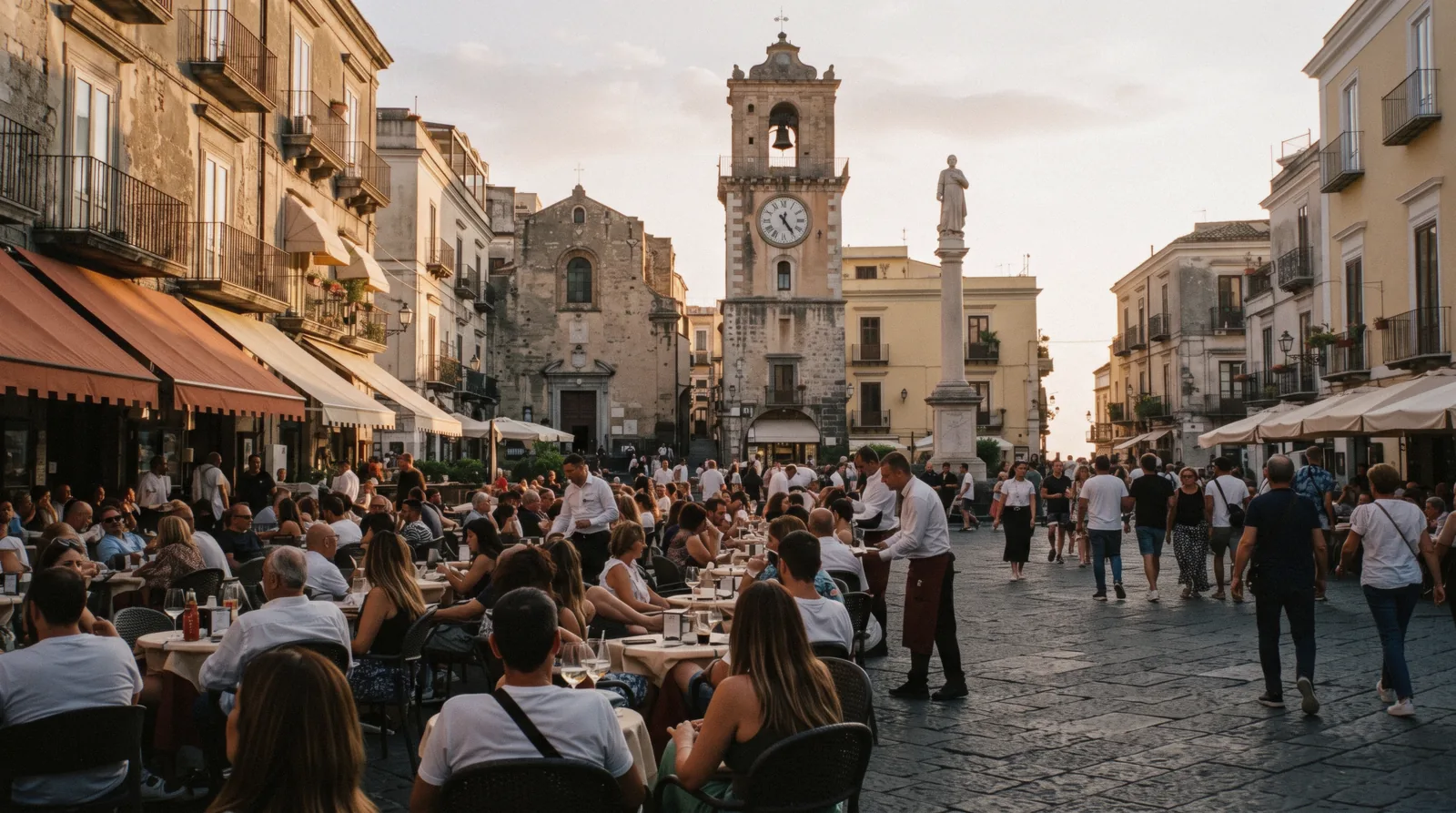
Piazza Tasso, Sorrento: the square, the statues and the gorge view
Piazza Tasso is the square every visitor crosses more often than they plan to: the zero point of Sorrento where Corso Italia narrows into the old town, the statue of the poet Torquato Tasso stands under a hotel facade, the Carmine church fills the east corner, and the north parapet drops a view straight into the Vallone dei Mulini gorge. It costs nothing, it closes never, and this page covers what the monuments actually are, the walk times out of the square, and how long the stop deserves.
Quick answer Free to cross, always open, the monuments on it, and the walk times out of it
Piazza Tasso is Sorrento's central square, free and open at all hours, named for the poet Torquato Tasso, who was born in the town in 1544. A statue of the patron saint Sant'Antonino stands mid-square, the yellow baroque church of Santa Maria del Carmine closes the east corner, and the north parapet looks down into the Vallone dei Mulini gorge.
Key takeaways
- There is no ticket and no hour to beat; the decision is only where to stand first, and the Vallone dei Mulini parapet on the north side is the view people come for
- A guided orientation walk starts from this part of town and knits the square, the old town lanes and the viewpoints into one 2.5-hour loop
- The square is the hinge of the centre: the old town begins at its west corner and the walk down to Marina Grande starts on its north side
Key facts
Opening hours
| Daily, all year | Open ground, always accessible |
|---|
Closed None. It is a public square with no gate, ticket or barrier
Admission
- Adult
- Free. No ticket, turnstile or charge to stand in the square
- Free
- The square itself; the cafes and restaurants around it charge only for what you order
Planning it
- Time needed
- Not stated by any official source, because a square publishes none; our routing: 15 minutes for the monuments and the gorge view, 30 if you sit down
- Address
- Piazza Tasso, 80067 Sorrento (NA), where Corso Italia meets the streets running down to the two ports
Tickets and tours around Piazza Tasso
Standing in Piazza Tasso costs nothing, so this table compares the free option with the three guided walks that use the square as their reference point, priced as listed on the platform and checked on 12 September 2026.
The square itself is free, so the real money question is whether a guided walk adds enough to the streets around it.
| Option | Price | What you get | Cancel | Book |
|---|---|---|---|---|
| The square itselfAnyone happy to read this page, cross the square and work it out on foot | Free (no ticket exists) | The Tasso statue, the Sant'Antonino statue, the Carmine church front, the gorge parapet | Nothing to cancel | Official site |
| Walking tour with a local guide, 2.5 hFirst-morning visitors who want the whole centre decoded before they wander | $57 listed | A guide, the historic centre and its stories, starting near the square | Free up to 24 hours before | Check Availability |
| Walking tour with olive oil and limoncello tasting, 2 hWalkers who want the lanes plus a tasting stop at the end | $41 listed | A two-hour private walk through the old town with two tasting stops | Free up to 24 hours before | Check Availability |
| Heritage walk with sea views and a lemon grove, 3 hVisitors who want heritage and the sea-view side of town in one booking | $93 listed | Guide, the heritage streets, the cliff views and a lemon grove visit | Free up to 24 hours before | Check Availability |
Platform prices are the listed figures on 12 September 2026; the platform bills in your account currency. The square has no official ticket office, so the free row links the city's official tourism portal instead.
Walking tours that use Piazza Tasso as their landmark
Every card links to the operator's own page, where the date calendar shows live availability. Prices are the listed USD figures checked on 12 September 2026.
 from $57
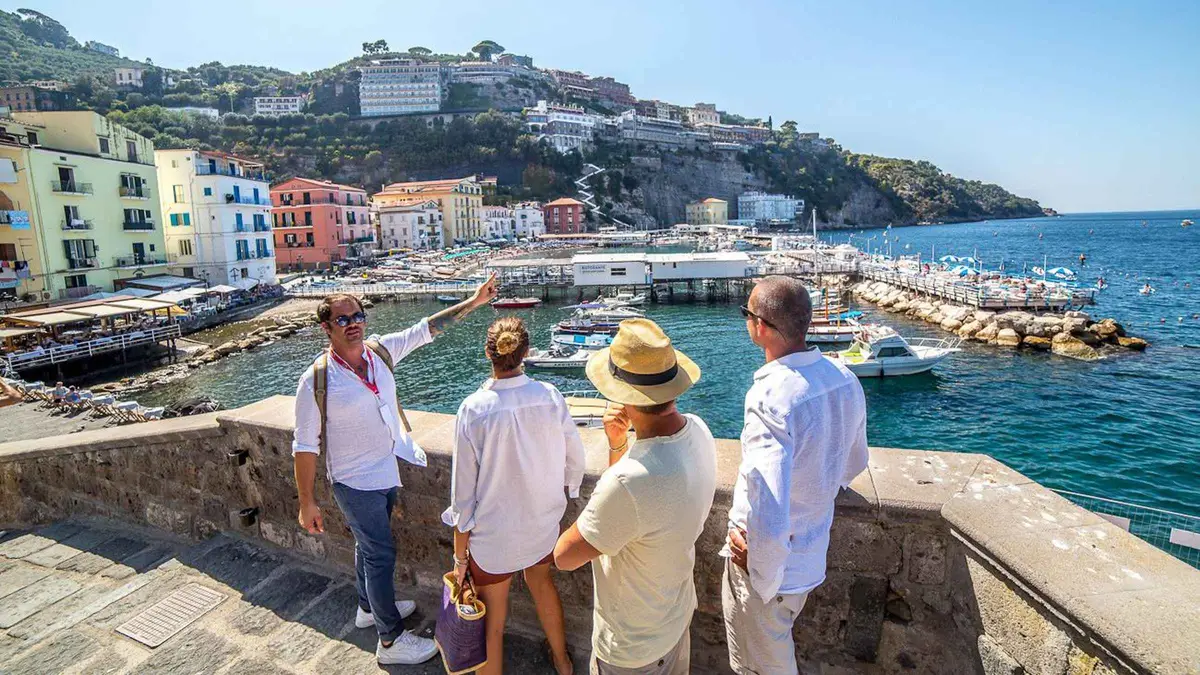
Sorrento: Walking Tour with Local Guide
A 2.5-hour private orientation walk with a local guide — the first-morning option.
Check Availability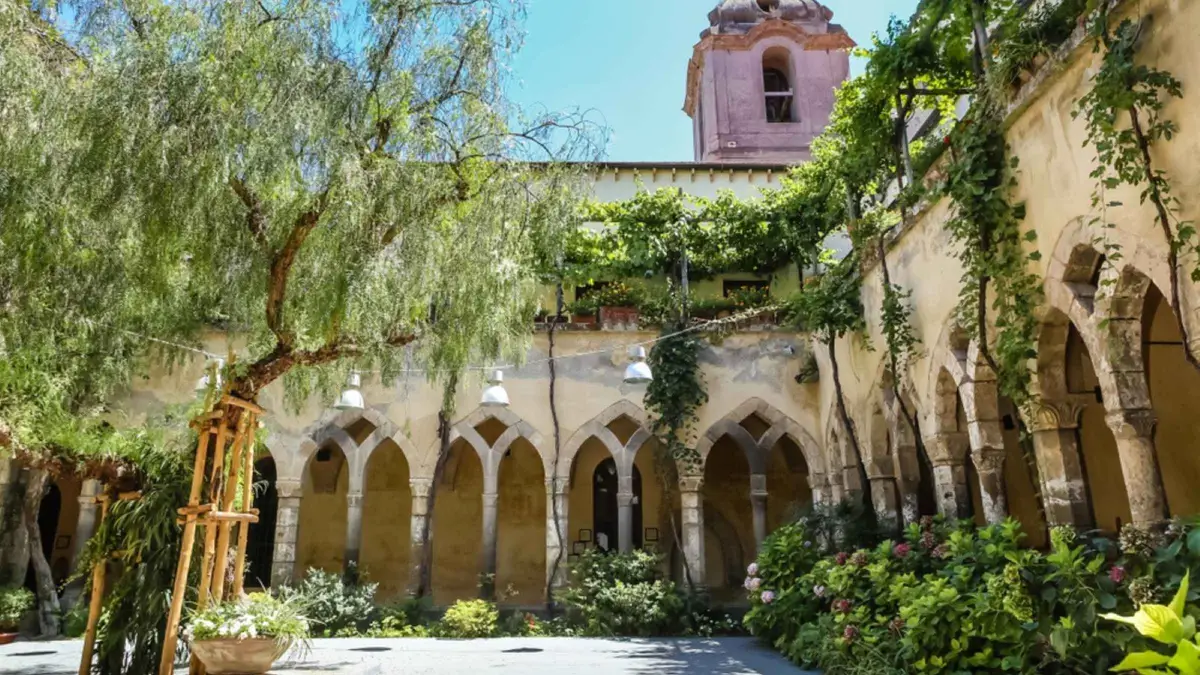 from $41
Sorrento: Walking Tour with Olive Oil and Limoncello Tasting
A two-hour private walk through the old town with olive oil and limoncello tasting stops.
Check Availability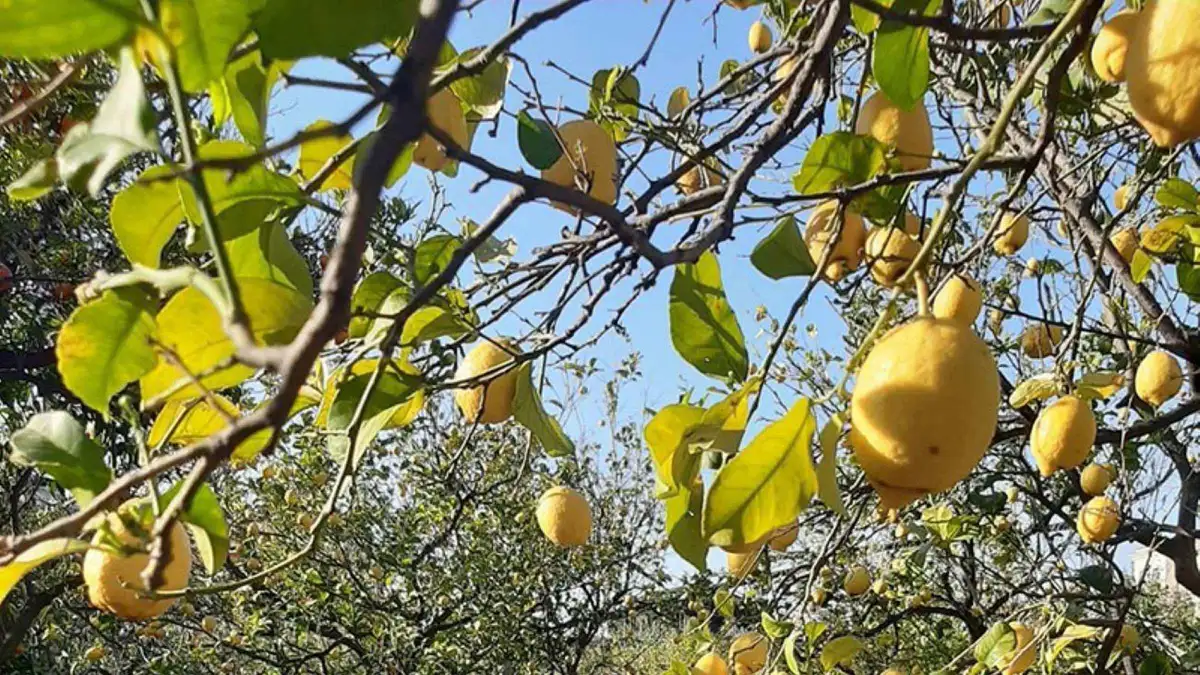 from $93
Sorrento Experience: Heritage Walk, Sea Views & Lemon Tour
A three-hour small-group heritage walk that ends at a lemon grove above the town.
Check AvailabilityPrices, ratings and details are the platform's own, checked in Q3 2026; dollar figures are the listed prices — the platform bills in your account's currency.
What the square is
Piazza Tasso is a flat, roughly rectangular square in the hinge of the town, where the modern main street, Corso Italia, hands traffic over to the lanes of the historic centre. Three things occupy it: a statue of the town's patron saint in the middle, a statue of the poet the square is named after at one corner, and a yellow baroque church front at the other end. Around those, the buildings are mostly hotels, banks and cafes, which is why the square reads less like a monument and more like the town's front room.
The name is newer than it looks. The space was known as Largo del Castello, after the Aragonese fortress that stood over it and protected the town. City planners demolished the fortress in the early 1840s as Sorrento expanded, and workers filled in sections of the deep gorge, the Vallone dei Mulini, to create the level surface the square sits on today. That fill is why the ground is stable enough for buses to turn on it, and also why the statue that was meant to stand in the centre had to be moved.
Treat the square as an instrument rather than a destination. Every direction from it is signposted by the thing you are walking towards: the descent towards Marina Piccola and the ferries, the lanes of the centro storico behind the Carmine church, the main street to the east, and the parapet where the ground simply stops and the gorge begins. Most people cross it five or six times a day without planning to, which is exactly how the town works.
The pick, in one sentence: come for the parapet view and the statues, give it half an hour with a coffee, and spend your real time in the streets leading off it, because the square rewards orientation more than sightseeing.
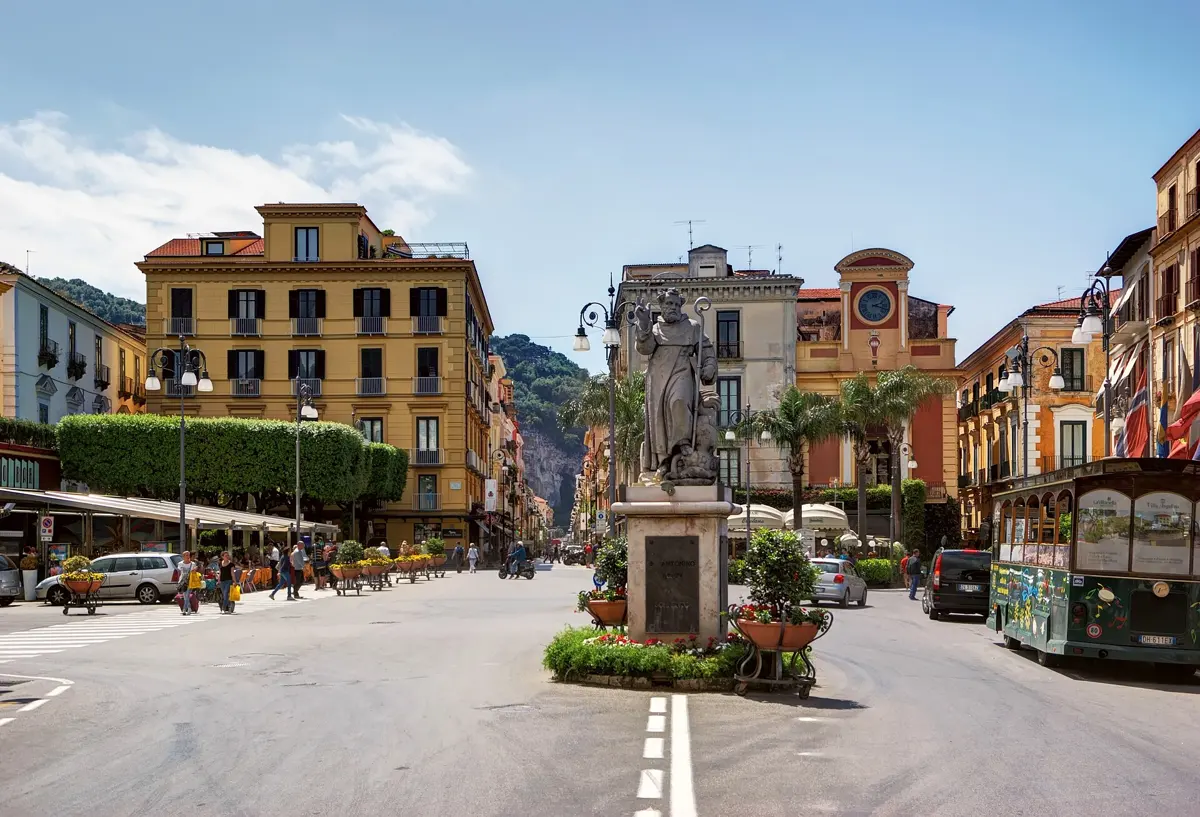
The square from the Corso Italia side: the Sant'Antonino statue in the foreground, Santa Maria del Carmine beyond it, and the green gap of the Vallone dei Mulini opening between the buildings. Photo: Berthold Werner, CC BY-SA 3.0, via Wikimedia Commons.
The monuments on the square, named
Four structures carry the square's history, and each takes about two minutes to read properly.
The statue of Sant'Antonino stands at the centre. Sant'Antonino is Sorrento's patron saint, and local tradition places his refuge here during the Lombard invasions; the statue marks the spot linked to the fortress's main tower, which ties the town's religious and military past into one pedestal. It is the meeting point every local gives on the phone, and the reason the square's crowd always seems to be walking in circles: they are looking for someone they last saw under the saint.
The statue of Torquato Tasso stands where Corso Italia meets Via della Pietà. Tasso was born in Sorrento in 1544 and is best known for the epic poem Jerusalem Delivered. The sculptor was Gennaro Calì, and the statue was inaugurated in 1870. The placement is an accident of geology: planners meant it for the centre of the square, but the filled-in gorge could not safely carry the weight, so it was set on the corner instead, where it has stood ever since, facing the traffic rather than the sea.
The church of Santa Maria del Carmine closes the eastern corner. Built in 1572, baroque in style and officially the Sanctuary of the Madonna del Carmine, it is the yellow facade partly swallowed by the adjoining cafe, which is the most Sorrentine detail on the square: sacred and social life sharing a wall. Inside there is a single nave, paintings of the Neapolitan school, and a copy of the Brown Madonna; the art historian's line is an Onofrio Avellino painting of the Virgin Mary with Saint Simon Stock and angels. It is a working church, so dress and volume rules apply.
Palazzo Correale overlooks the square from one side. Rebuilt in 1768, a noble residence with a tiled courtyard, it belongs to the same family name as the Museo Correale a few minutes east, and it supplies the square's one aristocratic facade. You look at it rather than enter it; the collection lives at the museum.
The Vallone dei Mulini view from the square
The reason Piazza Tasso earns its place on any walking route is on its north side, where the ground stops. The parapet looks into the Vallone dei Mulini, the deep gorge carved by ancient streams that the town grew across. From the square you see the road descending towards Marina Piccola with the sea beyond it, and directly below, wrapped in dense greenery, the ruins of an old mill that once ground flour down in the damp of the ravine.
The gorge itself is closed to visitors; nobody walks down there, and the fence and the ferns are doing structural work as much as scenic work. The view is free, takes about five minutes, and behaves differently by hour: before 10:00 the sun is still on the far wall and the mill ruins read clearly, by midday the light flattens into the ravine, and in the late afternoon the whole cut goes soft and photographic again.
For a clearer look, walk a short stretch up Viale Enrico Caruso, where the angle opens over the chasm, and the deep ravine behind the hotels becomes obvious: this is the crack in the tuff that gave Sorrento its defensive edge. The full story of the mills, the abandoned sawmill and the vegetation that closed over them is on the Vallone dei Mulini page; the square owns the first view of it, and the parapet is the only place on the square where a queue ever forms, for photographs, in the hour before sunset.
Cafes and what they cost on the square
The square is lined with outdoor tables, and the classic stop named in almost every guide is Fauno Bar on the square's west side: morning coffee standing at the counter, aperitivo under the lights in the evening. The surrounding streets carry the shopping layer of the town: intarsia woodwork, painted ceramics and leather sandals, which is why the square is both a café stop and a shopfront at the same time.
Now the honest part about prices: no official source publishes a price list for any of the cafes on the square, so no figure is printed here. The venues set their own menu prices, they change with the season, and the online figures that circulate on review sites are snapshots, not quotes. The check that matters takes ten seconds at the door: every venue must display its menu with prices, and on the square the difference between the counter price and the seated, table-served price is exactly the kind of thing that surprises visitors who sit down without looking.
Two practical habits from the comparison: take a table on the square edge only if the people-watching is the point, because the same coffee costs less two lanes inward on the old town side; and order at the bar if you are timing a departure, because table service on the square runs at the pace of the view, not the train timetable.
How much time to give Piazza Tasso
The square is the start of three different visits, not one. The table below routes them: what each version covers, what it skips, and the door-to-door time from the moment you step off the bus or out of the hotel. Walk minutes are our estimates from GPS distances, and the guided times come from the operators' own durations.
Pick the row that matches the day you are having, not the square you wish you had: on a short port call the crossing is enough, and on a first morning the guided loop earns its price by explaining the statues you would otherwise photograph without reading.
| Routing | Time door to door | What it covers | What it skips |
|---|---|---|---|
| The crossing | About 15 minutes | Sant'Antonino statue, Tasso statue, the parapet over the Vallone dei Mulini, a counter coffee | Church interior, Palazzo Correale courtyard, the old town lanes |
| The half visit | 30 to 45 minutes | Everything in the crossing, plus the Carmine church interior and the tiled courtyard glimpse of Palazzo Correale | The guided context; the lanes behind the church |
| With a guided walk | 2 to 2.5 hours | The square, the historic centre, the viewpoints and, on the tasting version, two stops with olive oil and limoncello | The beaches and the ports; those need their own hours |
The square in dates
Piazza Tasso's shape is a 19th-century project on a medieval footprint. The lines below put dates on what you are standing on.
-
before the 1840s
Largo del Castello, under the fortress
The space carried the fortress name while an Aragonese castle dominated the site and protected the town.
-
1544
Torquato Tasso is born in Sorrento
The poet of Jerusalem Delivered, later given the square's name, enters the world a short walk from where his statue now stands.
-
1572
The Carmine church rises on the east corner
Built in 1572, baroque in its later dress, it is the yellow facade that anchors the square's east end.
-
1768
Palazzo Correale rebuilt
The noble residence overlooking the square takes the form you see today, tiled courtyard included.
-
early 1840s
The fortress comes down, the gorge is filled
Planners demolish the Aragonese structure as the town modernises, and sections of the Vallone dei Mulini are filled to level the square.
-
1870
The Tasso statue is inaugurated
Sculptor Gennaro Calì's statue is meant for the centre of the square; the filled ground proves unreliable, so it is placed at the corner of Corso Italia and Via della Pietà instead.
-
December, every year
The Christmas tree takes the square
A large illuminated tree dominates the square, its lights changing colour through the evening, with families on the traditional evening walk.
Dates read from the English Wikipedia article on Piazza Tasso and the Exoticca guide bundled in the research file for this page, both read 12 September 2026; where the two sources overlap they agree.
Dos and don'ts at Piazza Tasso
Six decisions that make the stop work, all of them argued in the sections above. Each is an action you can take the moment you arrive.
Do
- Walk the north parapet first, before 10:00 if you can, when the sun is still on the mill ruins in the gorge
- Use the Sant'Antonino statue as your meeting point if your party splits up, because every local navigates by it
- Read the displayed menu at the door before taking a square-side table, then decide whether the people-watching is worth the delta
- Take the five-minute detour up Viale Enrico Caruso for the open angle over the chasm behind the hotels
- Come back after dark in December, when the illuminated tree and the evening strollers change the square completely
- Start the old town walk from the square's west corner, where Via San Cesareo leads off
Don't
- Don't plan to drive to the square; the calmed centre pushes cars to the garages, and the nearest is a short walk away (parking in Sorrento)
- Don't look for a way down into the Vallone dei Mulini from here; the gorge is closed to visitors everywhere
- Don't confuse the two ports when someone says 'walk down to the water'; Marina Piccola is ferries and Marina Grande is the fishing harbour
- Don't budget the square its own hour; it earns 15 to 30 minutes and hands you on to the streets
- Don't photograph the Tasso statue from the middle of the road; the corner position wants you on the pavement by Corso Italia
Five things most visitors do not know about Piazza Tasso
The square hides its history in plain sight. Five details, each with its source, that change what you are looking at:
- The square is standing on a filled-in gorge. Workers levelled the site in the 1840s by filling sections of the Vallone dei Mulini, and the ruins you photograph from the parapet are below street level because the ground was made, not found [Exoticca guide to Piazza Tasso, bundled in this page's research file].
- The Tasso statue moved because of that fill. It was planned for the centre of the square, but the made ground could not carry it, so Gennaro Calì's 1870 statue was set on the Corso Italia corner instead [Exoticca guide to Piazza Tasso].
- The square's real name was Largo del Castello. It kept the fortress's name until the Aragonese castle was demolished in the early 1840s, so every map older than about 150 years calls it something else [Exoticca guide to Piazza Tasso].
- The Carmine church holds a signed Old Master. Inside the single-nave church hangs a painting by Onofrio Avellino of the Virgin Mary with Saint Simon Stock and angels [English Wikipedia, Piazza Tasso].
- The poet never saw his square. Torquato Tasso was born in Sorrento in 1544 and died in 1595; the square took his current name and shape three centuries later, which is why his statue faces traffic rather than a view of anything he knew [English Wikipedia, Piazza Tasso].
Getting there and the walking times
The square is the easiest address in town to reach on foot, and the walk times below are our estimates, computed from GPS distances between the verified pins on the Sorrento map.
From the Circumvesuviana station, the square is a five-minute flat walk: come out of the station, face the sea, and follow Corso Italia straight down; the square opens at the end of the street. From the SITA bus stop for the Amalfi Coast at Piazza De Curtis, count the same five minutes, west along the main street. Local buses stop on the square itself, which is why most hotel descriptions use it as their landmark.
Downwards, two descents matter. The walk from the square to Marina Grande, the fishing harbour, runs about 12 to 14 minutes downhill through the lanes, closer to 15 on the way back up; the straight-line distance is short but the route bends. The descent towards Marina Piccola, the ferry port, is quicker, roughly 8 to 10 minutes, and passes the parapet view on the way.
Into the old town, Via San Cesareo begins at the square's west corner, two minutes from the Tasso statue. The basilica of Sant'Antonino sits two minutes west of the square on its own small piazza, which makes the pair the shortest sightseeing hop in town. The one arrival that is slower than it looks is by car: the centre is largely closed to through traffic, and the practical move is a garage on the edge followed by a walk (parking in Sorrento).
Piazza Tasso map: monuments, parapet and the walks out
The square's own pins, plus the sights within a five-minute walk. GPS coordinates from Wikidata and the site's verified map.
Nearby Piazza Tasso: the three stops that pair with it
Walk minutes are our estimates from the GPS distances between the verified pins.
Basilica di Sant'Antonino
The patron saint's own church, with the crypt where devotion to Sant'Antonino actually happens and the whale bones in the porch. Free to enter; the pair of squares makes the shortest sightseeing loop in town.
2 min walk, west across the traffic lightsVallone dei Mulini viewpoint
The deep gorge with the mill ruins that the square was built over. Closed to descents, open to looks, and best before the midday light flattens it.
1 min, north parapet of the squareMarina Grande
The fishing harbour with the fish restaurants on the water. Do it as the descent, lunch at the water, and the climb back before the evening.
12 to 14 min downhill through the lanesPiazza Tasso questions
Is Piazza Tasso worth visiting?
Worth crossing, deliberately, at least twice: once for the two statues and the Carmine church, once for the parapet view into the Vallone dei Mulini. It is free, and it is the orientation point for everything else; pair it with the old town lanes rather than budgeting it an hour of its own.
What is Piazza Tasso known for?
Three things: the name, honouring the poet Torquato Tasso born in Sorrento in 1544; the mid-square statue of Sant'Antonino, the town's patron; and the view into the gorge. The Vallone dei Mulini page covers the ravine; the statues are covered above.
Can you walk to Piazza Tasso from the train station?
Yes, and it is the easiest walk in Sorrento: about five minutes, flat, straight down Corso Italia from the Circumvesuviana station. No stairs, no crossings worse than a zebra, and the square opens at the end of the street.
How long is the walk from Piazza Tasso to Marina Grande?
About 12 to 14 minutes downhill through the lanes, a little longer coming back up; the straight-line distance is under a kilometre but the route bends. The harbour's fish restaurants and beaches are on the Marina Grande page.
Do you need a ticket for Piazza Tasso?
No. The square is public ground, open at all hours, with no ticket or barrier; the only money on it is what the cafes and restaurants charge for what you order. It features on the free things to do in Sorrento list for exactly that reason.
Where do you park for Piazza Tasso?
Not on it. The centre is largely closed to through traffic and the garages sit on the edge of town, the nearest a few minutes' walk away. The realistic options and the seasonal prices are compared on the parking in Sorrento page.
Is there anywhere to eat on Piazza Tasso?
Yes, the square is ringed with cafes and restaurants, Fauno Bar being the classic named stop, but none of them publishes a verifiable price list online, so read the menu at the door and treat any figure on a review site as a snapshot. The food streets two lanes inward are compared on the where to eat page.
Where Piazza Tasso fits in a day
Morning, and the square is the first landmark you meet: come down from the station, take the parapet while the light is still on the mill ruins, then let the one-day itinerary hand you onwards. The middle of the day belongs elsewhere, the beaches, the ports or Pompeii, and the square will still be there, busier, on the way back.
Evening is when the square is at its most itself: the tables move outwards, the street performers start, and in December the tree switches on. If the day ends with dinner, the square is where the walk to the restaurant starts, whichever of the eating pages you are following. Across a longer stay, the two-day and three-day itineraries cross the square on every morning because the geography leaves no alternative, and none of them is wrong to.
The pick, in one sentence: give the square the first fifteen minutes of your first morning and the last hour of your first evening, and let a guided walk fill the space in between. When the town part of the plan is settled, the Sorrento city guide front page keeps the rest of the site one click away.
Piazza Tasso on film
Three walk-throughs verified on YouTube: what the place actually looks like before you book anything.
A Walk Through Sorrento City Centre | Sorrento | Italy | Naples | Things to Do in Sorrento
Verified via oEmbed (ConnollyCove); matched query 'piazza tasso sorrento'.
Video: ConnollyCove🇮🇹 SORRENTO Italy ❤️ Scenic Walk Marina Grande To Piazza Tasso
Verified via oEmbed (Let's Travel Again); matched query 'piazza tasso sorrento'.
Video: Let's Travel AgainTasso Square Sorrento
Verified via oEmbed (Sorrento With Bells On); matched query 'piazza tasso sorrento'.
Video: Sorrento With Bells OnVideos load from YouTube only when you press play.
Reviewed Q3 2026 (July–September 2026); next review Q4 2026. Prices, hours and terms are set by the venue or operator and confirmed at checkout.
We may earn a commission if you book through one of our links, at no extra cost to you. Full affiliate disclosure