 Sorrento City Guidebook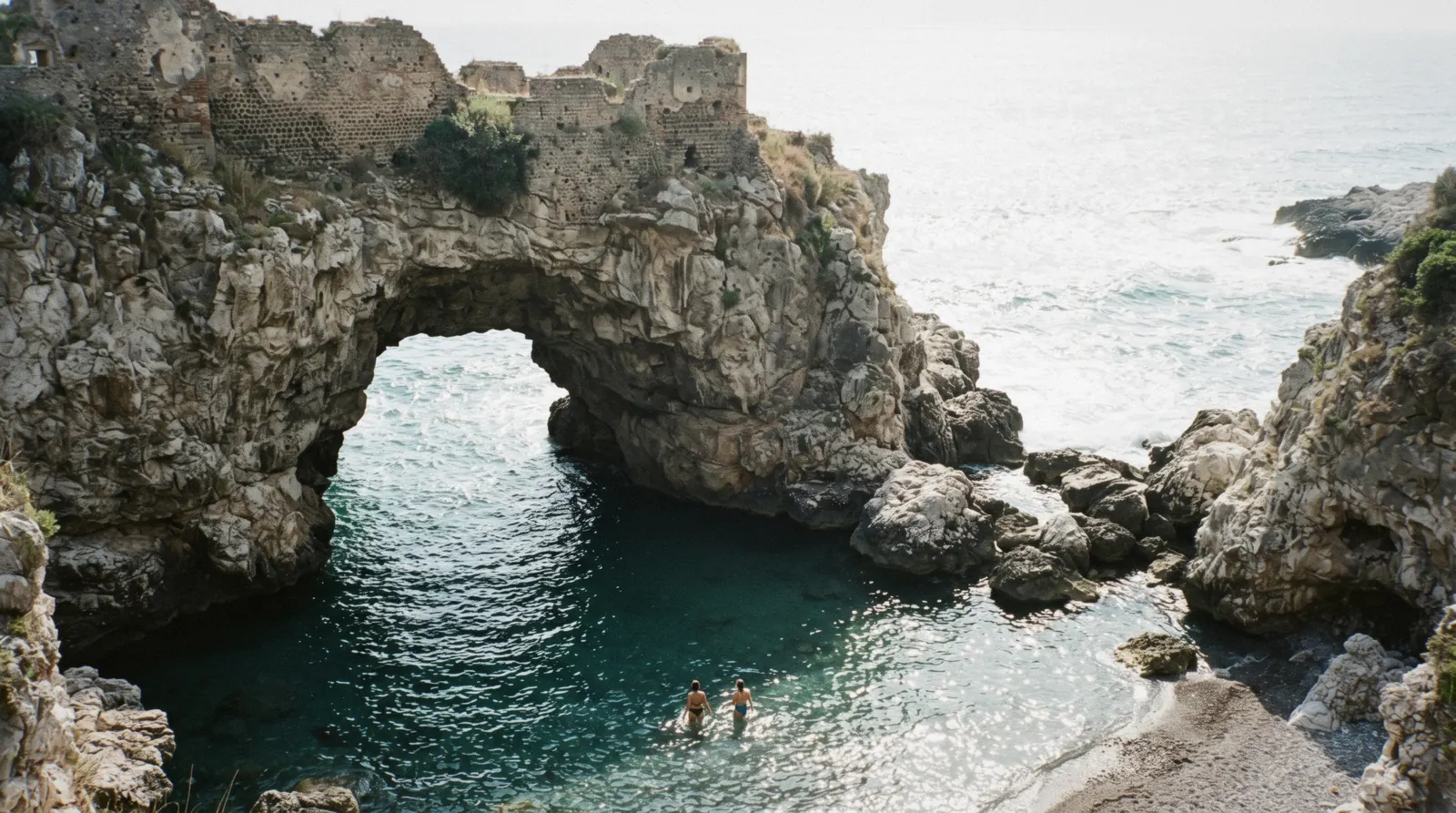
Bagni Regina Giovanna: the cove, the ruins and the walk out
Bagni Regina Giovanna is the natural pool at Capo di Sorrento where a ring of limestone cliffs holds a calm, pebble-floored lagoon that opens to the open sea through a single rock arch, and where the ruins of a Roman villa built for Pollio Felice in the first century BC still stand over the water. The Bagni Regina Giovanna are free, they are reached on foot, and they offer none of the services a beach club would: no lidos on the rocks, no lifeguard, no bins, which is exactly the bargain this page explains. It covers the swim, the ruins, the legend of the queen, the honest walk or bus out from Sorrento, and what to bring so the afternoon does not go wrong.
Quick answer Free entry, swimming through the arch, the ruins, and how long the walk really is
Bagni Regina Giovanna is a free natural lagoon at Capo di Sorrento, about 3.5 km west of Sorrento centre, where you swim in a calm pebble-floored pool that connects to the open sea through a rock arch. The cove is ringed by the ruins of the Roman villa of Pollio Felice from the first century BC, and it has no facilities at all: no lifeguard, no bars, no bins, no sand.
Key takeaways
- It costs nothing and needs nothing booked; the practical spend is water shoes, and the beaches in Sorrento page lists the equipped alternatives if you want a bed and a bar
- The walk from central Sorrento is 40 to 50 minutes each way; a one-hour coast cruise is the way to see the same cliff line from the water instead
- Bring water, shoes that grip and everything you brought back out: no bins means no waste collection on the rocks
Key facts
Opening hours
| Daily, all year | Open ground, always accessible |
|---|
Closed None. The cove is open ground on the Capo di Sorrento promontory with no gate or barrier
Admission
- Adult
- Free. No entrance fee of any kind (regional tourism board: 'access is free and there are no beach facilities')
- Free
- The lagoon, the ruins, the rocky terraces and the walk in
Planning it
- Time needed
- Not stated by any official source, because no managing body exists; our routing: half a day with the walk out, or 90 minutes if you drive to the top parking
- Address
- Traversa Punta Capo, 80067 Sorrento (NA), Italy; Capo di Sorrento promontory
The cove and the ways of seeing it
The free row is the cove itself, checked on 12 September 2026; the boat rows are the cruises that run the same coast from Marina Grande, priced as listed on the platform the same day.
Do you want to swim off the rocks yourself, or see the coast line from a boat with the swimming handled for you?
| Option | Price | What you get | Cancel | Book |
|---|---|---|---|---|
| The cove itselfSwimmers happy to carry their own water and walk in | Free (no ticket exists) | The natural pool, the rock arch, the Roman ruins, the rocky terraces | Nothing to cancel | Official site |
| Sorrento coast cruise with swim stop, 1 hTight schedules that cannot spend two hours walking out and back | $23 listed | A one-hour daytime cruise along the same coast with a swim stop and limoncello on board | Free up to 24 hours before | Check Availability |
| Golden hour boat experience, 1 hEvening visitors who want the cliffs in golden-hour light instead of at midday | $46 listed | A one-hour small-group sunset run out of Marina Grande with an aperitif | Free up to 24 hours before | Check Availability |
Access to the cove is free by the regional tourism board's own listing, read 12 September 2026; no ticket product exists for it. Platform prices are the listed USD figures on the same date; the platform bills in your account currency.
Boats that see the same coast you would swim at
No boat enters the lagoon itself, but the coast cruise out of Marina Grande runs the cliff line that frames it, with a swim stop at sea. Every card links to the operator's own page, where the date calendar shows live availability. Prices are the listed USD figures checked on 12 September 2026.
 from $23
Sorrento Coast Cruise with Limoncello Tasting
A one-hour daytime coast cruise with a swim stop and limoncello on board. The taster option for tight schedules.
Check Availability from $46
Sorrento: Golden Hour Boat Experience from Marina Grande
A one-hour golden-hour cruise out of Marina Grande with an aperitif. The shortest sea slot on this page.
Check AvailabilityPrices, ratings and details are the platform's own, checked in Q3 2026; dollar figures are the listed prices — the platform bills in your account's currency.
What the cove is
The Bagni Regina Giovanna sit on the Capo di Sorrento promontory, the blunt headland west of town that closes the Bay of Sorrento, inside the Punta Campanella protected marine area. Geologically the pool is a lagoon framed by limestone rocks eroded by wind and sea, connected to the open water by a narrow passage topped by a natural arch; inside the ring the water is calm and the seabed is pebbly, outside it the depth drops and the currents strengthen. The regional tourism board, which keeps the closest thing the cove has to an official page, describes it as a pristine basin in a wild setting, and the description holds: from the waterline you see ruins, cliff and open sea, and almost nothing built.
The name is a legend with a real queen attached. Giovanna II d'Angiò-Durazzo ruled Naples from 1414 to 1435, and the story that gives the Baths their name says the sovereign came here to bathe in the company of her young lovers, some of whom, the spicier versions add, did not leave. History places a statue of her in the church of San Giovanni Carbonara in Naples; legend places her parties in this pool. Both can be true enough for a swim.
What surprises most first-time visitors is the size of the place. The pool is the headline, but the promontory around it is a small archaeological landscape of walls, terraces and lookouts with the Gulf of Naples spread behind: Vesuvius across the water, Ischia and Procida to the north-west, and the whole sweep of the bay on the walk in. The light at the cove is at its best in the early morning and at sunset, which is also when you will share it with the fewest people.
The pick, in one sentence: come for a half day, swim early or late, and treat the walk as part of the visit rather than the price of it.
The Roman villa behind the name
The ruins ring the pool because the pool was the villa's own. The domus dates to the first century BC and belonged to the Roman nobleman Pollio Felice, and the seaside estate was immense: at least 30,000 square metres, with a further residence connected to the main one by tunnels and underground passages, the lower one used for fishing and farming. The natural pool the queen allegedly swam in was, a millennium and a half earlier, the villa's fish pond and harbour, and the passageways and terraces around the cove make the connection visible without a single signboard.
Today only ruins remain, on top of the Capo Sorrento promontory and down to the waterline, and the area is an archaeological site as well as a swimming spot: on the way to the Baths, various finds can be seen along the path. The masonry is scrambleable in places and the terraces make natural sun decks, which is the visit's unique trick: you are sunbathing on a Roman floor plan. Nothing is fenced, nothing is ticketed, and nothing is explained on site, so the ruins reward either a guide's context or ten minutes of reading before you go.
One honesty note on the name: the Romans and the queen are a millennium apart, and the 'Bagni' title is a later legend laid over Roman stones. The villa of Pollio Felice is the documented structure; Queen Giovanna is the story that named it. The swim is the same either way.
Swimming through the arch
Yes, you can swim, and the pool is the most sheltered water on this stretch of coast: the ring of cliffs blocks the swell and the pebble seabed shelves gently enough for wading, while the arch opens a lane to the open sea for the confident. The regional board's advice is worth repeating verbatim: dive in, but beware of the open sea, where the seabed becomes deep and the currents become stronger. The pool is for floating; the arch is for looking through and swimming through on a calm day, with the outer water watched.
The seabed is pebbly, and the terraces you sit on are rock. Water shoes are the difference between an afternoon and an endurance test, and every serious description of the cove converges on the same kit list: water, food, sunscreen, towel, rock shoes. There is no sand anywhere in the cove, only small rocky terraces, so a towel on stone is the format; a thin mat doubles the comfort.
Three swimming practicals. First, the water is clearest in the morning before the day's feet stir the shallows. Second, the pool's calm is a fair-weather promise: after a rough sea the arch channels swell into the ring, and the pool that was a millpond on Tuesday can be boisterous on Friday, so read the water before committing to the outer passage. Third, there is no lifeguard at any hour; the cove's safety margin is you, your party and the shoes on your feet.
Getting there: walk, bus or car
No transport reaches the cove itself; every route ends in a walk of 15 to 20 minutes along the signed path from the Capo di Sorrento area, following the signs for the Ruderi Romani, the Roman ruins. The question is only how you cover the 3.5 km between Sorrento centre and the start of that path.
On foot from the centre is the walker's answer and the one the guides under-rate: count 40 to 50 minutes each way, computed from the GPS distance of about three kilometres of road plus the path, partly along the coast road with the harbour below you. The route passes above Marina Grande and then the villas of the Capo; comfortable shoes do it, and the morning version is the pleasant one. The regional board's shorter figure of 15 to 20 minutes starts from Capo di Sorrento itself, not from town, which is why our two numbers do not contradict each other.
By bus, the local line from Sorrento toward the Capo stops on Via Capo at the stop named for the cove, a few minutes' walk from the parking and the path; the fare is not published on any page we read on 12 September 2026, so confirm at the stop or on the operator's notices, and treat the ride as the reserve option for heat or tired legs. By car or scooter, the nearest parking is on Via Calata Punta Capo, paid, with the fee not published on any official page we read; arrive early in July and August or the small lot decides your morning for you.
The table compares the three ways honestly, including what each one costs you that is not money.
Pick by legs and heat rather than by principle: the walk is the best hour of the day if it is the cool hour, and the bus is the best idea if it is not.
| Way | Time to the cove | Cost | The catch |
|---|---|---|---|
| Walk from the centre | 40 to 50 minutes each way | Free | The return climb in August heat is the day's real cost |
| Local bus toward Capo | Ride plus a 15 to 20 minute path | Fare not stated on any official page we read | Sunday and evening frequencies are thinner; check the stop board |
| Car or scooter | Drive plus a 15 to 20 minute path | Paid parking on Via Calata Punta Capo; fee not published | The lot is small and empties early in peak season |
What it does not have, and why that is the deal
Make the list explicit, because the disappointment reviews are all the same review: no bars or restaurants on the rocks, no umbrella or bed rentals, no beach facilities, no lifeguard, no bins, and no sand beach, only rocky terraces. The regional tourism board prints the same negatives as facts, and the cove's beauty is downstream of them: nothing disturbs nature here because nothing is allowed to set up here.
The absence with consequences is the bins. Waste collection does not exist on the site, so the rule is load in, load out; every wrapper you carry in leaves with you. Pack a bag for it and the deal holds. The absence with safety consequences is the lifeguard: children on the terraces and swimmers at the arch are supervised by nobody, and the board itself flags the route and the rocks as unsuitable for people with reduced mobility and genuinely demanding for small children.
The absence people underestimate is shade. The promontory's scrub is low, the terraces face the water, and for most of the day there is nowhere to hide from the sun except your own umbrella, which is why the board's kit list leads with water and provisions. Come equipped for a small expedition and the cove pays you back; come equipped for a beach club and it cannot, at any price, because there is nothing to buy.
Where to eat instead, and the lido nearby
Nothing sells food at the cove, so the eating question is a routing question. The close answer is back in town or along the return route: the fishing harbour of Marina Grande, with its fish restaurants on the water, is the natural lunch or dinner stop either side of a cove morning, and the town centre's food streets are compared on the where to eat page.
The near answer is the lido a few hundred metres along the coast: the national tourism board's own page for the Baths points swimmers who want comfort toward the Lido la Solara, the equipped beach at the Capo, for the afternoon version of the same water. The lido charges for what lidos charge for, beds and service, and those figures are the lido's own to publish; none are quoted here because we could not verify them on an official page this run.
One more option belongs on the list because it reverses the geometry: seeing the same coast from the water. The one-hour coast cruise from Marina Grande runs the cliff line the cove sits in, with a swim stop at sea and no walking at all, which is the honest alternative for legs that will not do the 40-minute walk twice in August heat. It will not put you inside the lagoon, nothing does, but the arch and the promontory read grandly from a boat.
Best time of day and how long to stay
No official source publishes a duration or a best hour for a place with no manager, so this is routing, and the routing is clear. The regional board's own advice for the season is spring or early autumn for mild weather and thinner crowds, and in summer, early morning or late afternoon to avoid both the peak heat and the peak people. The same advice doubles as the light advice: the early morning sun puts the pool in its clearest calm, and the sunset version turns the cliffs gold with Vesuvius black behind.
The table routes the three realistic visits by what you actually want from the cove; walk times are our estimates from the GPS distances, and every version ends with carrying your own waste out.
Choose by swim versus expedition: the morning version is the swimmer's, the afternoon version is the explorer's, and the combination is the half day the cove deserves.
| Routing | Time door to door | What it covers | What it skips |
|---|---|---|---|
| The morning swim | About 3 hours from the centre | The walk out in cool air, a long swim in the calm pool, the walk back before the heat | The villa terraces explored properly; the sunset |
| The ruins afternoon | About 4 hours | The path in, the Roman walls and tunnels scrambled, the pool late, the bus or a dinner stop back | The mirror-calm morning water |
| The half-day full version | About 5 hours | Walk out, swim, ruins, and the golden-hour light on the return along the Capo | Nothing at the cove; only the town's afternoon sights |
Dos and don'ts at Bagni Regina Giovanna
Six decisions that make the cove work, all argued in the sections above.
Do
- Pack the kit the board names: water, food, sunscreen, towel and rock shoes, plus a bag for carrying the waste out
- Swim early or late; the pool is calmest and clearest in the morning, and the cliffs burn gold at sunset
- Watch the open sea past the arch, where the seabed drops and the currents strengthen, and swim the outer passage only on a flat day
- Scramble the Roman terraces of the villa of Pollio Felice; the ruins are the visit's bonus and they are unfenced
- Take the bus or drive if the temperature is over 30; the 40-minute walk each way is a morning pleasure and an afternoon punishment
- Pair the day with lunch at Marina Grande on the way back into town
Don't
- Don't expect services of any kind: no bars, no beds, no lifeguard, no bins; the regional board prints all four as facts
- Don't go in beach-club mode with nothing to eat or drink; the nearest food is a walk or a ride away
- Don't leave children unwatched on the terraces or at the arch; nobody is on duty here, ever
- Don't try it with prams or limited mobility; the path is steep in sections and the rocks are impervious, per the board's accessibility note
- Don't drive at 11:00 in July; the small paid lot at Via Calata Punta Capo empties early and decides your morning otherwise
- Don't settle for the road when the light matters; the viewpoint moments are sunrise and sunset, and the golden hour cruise is the no-walking version
Five things most visitors do not know about Bagni Regina Giovanna
The details that change what you are looking at, each with its source in brackets:
- The pool was a Roman fish pond. The villa of Pollio Felice, built in the first century BC, was an estate of at least 30,000 square metres with a secondary residence connected by tunnels, and the lagoon was part of its working water system [Italia.it, the national tourism board's page for the Baths].
- The queen is real, the orgies are legend. Giovanna II d'Angiò-Durazzo ruled Naples from 1414 to 1435 and has a statue in Naples's San Giovanni Carbonara; the bathing-with-lovers stories are the later legend that named the pool [Italia.it].
- No transport reaches the cove, by design. Every route ends in a 15 to 20 minute signed walk from Capo di Sorrento following the Ruderi Romani signs; the board is explicit that the site is reachable only on foot [Visitcampania, Queen Giovanna's Baths].
- There are no bins, so there is no cleaning. The board's rule for the site is to take your waste away, and the cove's untouched look is the direct product of that rule holding [Visitcampania, Queen Giovanna's Baths].
- The board's own plan B is a lido. For comfort after the pool, the national tourism board points visitors to the equipped Lido la Solara a few hundred metres along the coast [Italia.it].
Bagni Regina Giovanna map: the cove, the path and the town behind it
The cove pin is the OpenStreetMap coordinate for the lagoon beach, cross-checked against the Roman villa node beside it; the town pins are the site's verified coordinates, with drive and walk minutes estimated from GPS distances.
Nearby Bagni Regina Giovanna: the three stops that pair with it
The cove is 3.5 km out of town, so the honest neighbours are the stops on the way back; minutes are our estimates by car or bus from the GPS distances.
Marina Grande
The fishing harbour with the fish restaurants on the water. The lunch or dinner stop either side of a cove morning, and the boats to the coast leave from here.
About 10 min back toward town by car or busPiazza Tasso
The town's zero point for the evening: the square, the gorge parapet and the lanes of the old town, all within minutes of the bus stop you arrived at.
About 12 min by car or bus, the centreVilla Comunale
The public gardens over Marina Piccola with the sunset view. The paved, seated version of the cliff-top scenery you just walked, with the ferry port below.
About 13 min by car or bus, the cliff gardensBagni Regina Giovanna questions
Is Bagni Regina Giovanna worth it?
Yes, if you want the wildest swim on this stretch of coast and accept self-sufficiency: a free natural pool behind a rock arch, ringed by Roman ruins, with no lifeguard, no bar and no bins. If you want beds, service and sand, the equipped beaches are the better spend and the cove will only frustrate you.
Is Bagni Regina Giovanna free?
Yes, completely: no entrance fee, no ticket office and no barrier, confirmed by the regional tourism board's own listing. The only possible costs are the paid parking on Via Calata Punta Capo if you drive, its fee not published, and whatever the local bus charges if you ride it, also not published.
Can you swim at Bagni Regina Giovanna?
Yes, and the pool is the most sheltered water on the coast here: calm, pebble-floored and ringed by cliffs, with the rock arch opening to the open sea. Stay in the pool unless the sea is flat, because past the arch the seabed drops and the currents strengthen, and there is no lifeguard at any hour.
Can you walk to Bagni Regina Giovanna from Sorrento?
Yes: about 40 to 50 minutes each way from the centre, roughly three kilometres of road plus the signed 15 to 20 minute path from Capo di Sorrento following the Ruderi Romani signs. It is the walker's version of the trip and pleasant in the cool hours; the bus toward the Capo and a paid lot near the path are the alternatives.
How do you get to Bagni Regina Giovanna by bus?
Take the local line from Sorrento toward the Capo and get off at the stop on Via Capo named for the cove, then follow the signs for the Ruderi Romani along the 15 to 20 minute path. The fare is not stated on any official page we read on 12 September 2026, so confirm at the stop; frequencies thin out on Sundays and evenings.
Are there restaurants at Bagni Regina Giovanna?
No: the regional board is explicit that there are no bars, restaurants or beach facilities at the cove. The near option is the equipped Lido la Solara a few hundred metres along the coast, named by the national tourism board, and the good option is lunch at the fish restaurants of Marina Grande on the way back.
Do you need water shoes at Bagni Regina Giovanna?
Yes. There is no sand, the seabed is pebbly and the terraces are bare rock, and every serious description of the cove converges on the same list: rock shoes, water, food, sunscreen, towel. They are the difference between a long swim and a short ordeal.
Where Bagni Regina Giovanna fits in a trip
The cove is a half-day commitment, not a stop, and the itineraries that work are the ones that plan around the walk. On a short stay it is the swim of the trip: the one-day itinerary leaves it out on purpose, because a one-day visitor spends the water budget on the harbour swim or a boat hour instead. On a two-day or longer base it slots as the afternoon of a town day or the morning of a no-ferry day, and it pairs perfectly with a late lunch at Marina Grande on the return.
Its rivals for the same half day are the boat version and the equipped version. If the legs are willing, the cove beats both, because no cruise passes through the arch and no lido rents you a Roman terrace; if the heat is over 30 or the party includes small children or limited mobility, the golden hour cruise or the lido beat the walk, honestly. The season answer is spring and early autumn, when the board itself sends people here and the pool belongs to the swimmers who arrive at eight.
The pick, in one sentence: make it the swim day of your stay, start before ten or after five, carry the kit the board lists, and let the queen keep her legend while the Roman stones keep the shade off your towel. When the town part of the plan is settled, the Sorrento city guide front page keeps the rest of the site one click away.
Bagni Regina Giovanna on film
Three walk-throughs verified on YouTube: what the place actually looks like before you book anything.
SORRENTO HIDDEN GEM | Bagni Regina Giovanna
Verified via oEmbed (Andrew & Kait); matched query 'bagni regina giovanna sorrento'.
Video: Andrew & KaitSORRENTO HIDDEN GEM BEACH 🇮🇹 | Bagni Regina Giovanna, Amalfi Coast | 4K Walking Tour
Verified via oEmbed (Travel Centric | Luxury Walking Tours); matched query 'bagni regina giovanna sorrento'.
Video: Travel Centric | Luxury Walking ToursBagni Regina Giovanna, Sorrento, Italy | 4K Drone
Verified via oEmbed (Nemanja Stojanovic - Travelling); matched query 'bagni regina giovanna sorrento'.
Video: Nemanja Stojanovic - TravellingVideos load from YouTube only when you press play.
Reviewed Q3 2026 (July–September 2026); next review Q4 2026. Prices, hours and terms are set by the venue or operator and confirmed at checkout.
We may earn a commission if you book through one of our links, at no extra cost to you. Full affiliate disclosure